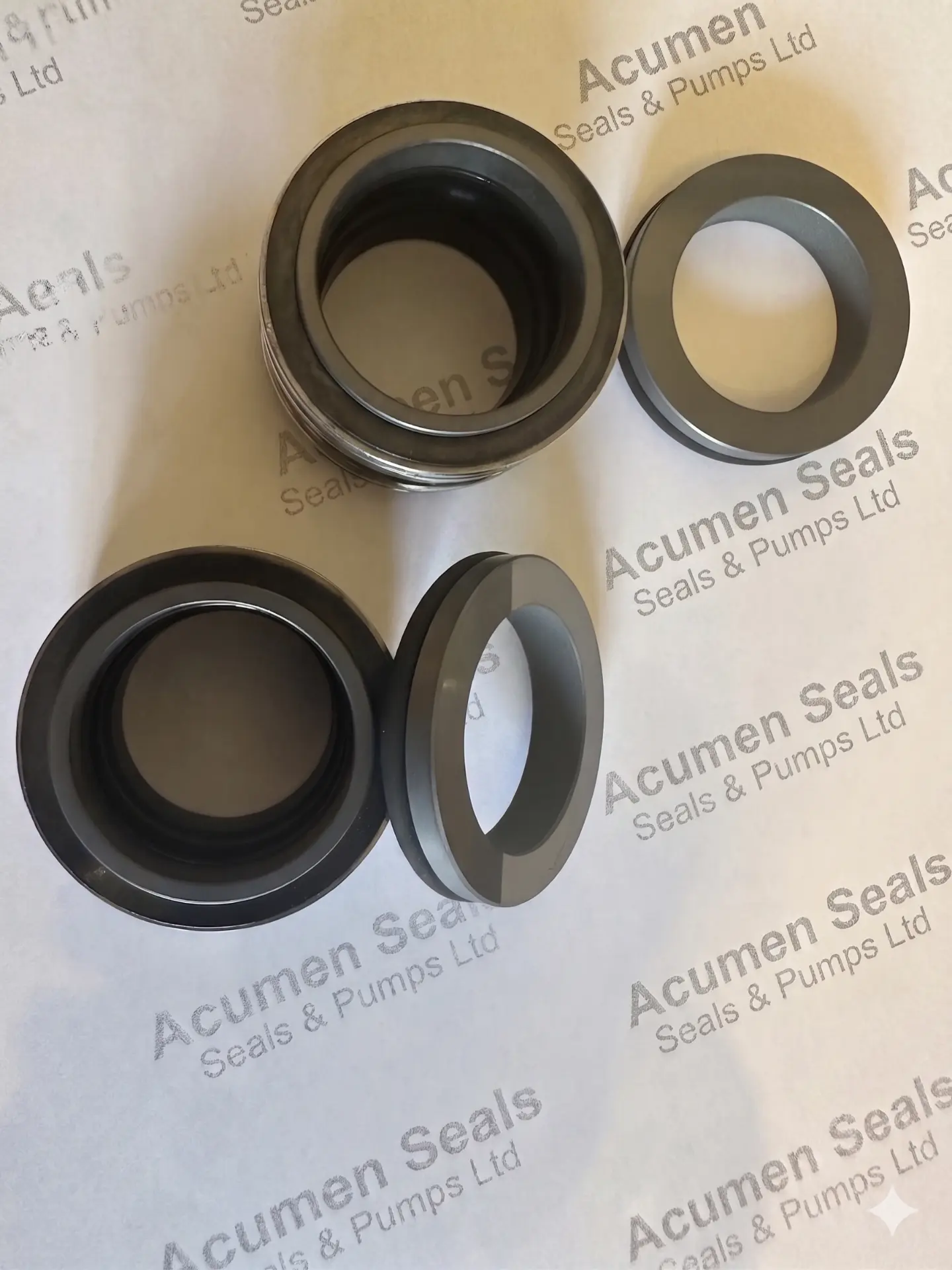
Lowara Pump Mechanical Seal Replacement
Lowara stainless steel pumps are common across the UK in water boosting, heating and cooling systems, and clean process duties. We select and supply equivalent mechanical seals to suit Lowara pumps, from small circulation pumps up to large vertical multistage units.
Where the seal sits in a Lowara pump
Most Lowara pumps run a single mechanical seal on the shaft between the pump and the motor. On the popular e-SV vertical multistage range the seal is a standard-dimension (EN 12756) mechanical seal, a balanced design on the larger sizes, and on most sizes it can be replaced without removing the motor from the pump. When the seal wears, the pump weeps from between the pump head and the motor - a planned change is far cheaper than running it to a failed motor.
Identifying the seal your pump needs
Each Lowara model and size takes its own seal, so the starting point is the pump itself. The model and serial number on the pump plate narrow it down. A photo of the old seal, or its shaft size and seat dimensions, settles it. We check every enquiry against the pump model before we quote, so listing Lowara here does not mean every model is covered.
Materials for the duty
The fluid and temperature decide the seal materials. Clean water and heating duties usually call for carbon or silicon carbide faces with EPDM elastomers; where the pump handles something more aggressive, harder faces and different elastomers may be needed. Tell us what the pump handles and we will match the seal to it.
While the pump is apart
A new seal lasts longest on a healthy pump. Worn bearings or a worn shaft sleeve will shorten the life of any seal, so they are worth checking while the pump is open.
Common questions
What seal does my Lowara pump need?
It depends on the model and size. Send us the model and serial number from the pump plate, plus a photo of the old seal if you have one, and we will identify the equivalent seal and quote for it.
Can you supply seals for older Lowara models?
Usually, yes. Older models are a regular part of our work. A clear photo of the old seal and a few measurements is often enough to identify a replacement.
How do I know the seal is failing?
A steady drip or spray from between the pump head and motor is the usual sign. If the pump is leaking or tripping, stop it and get the seal checked before the motor is damaged.
Solutions related to this article
If this failure mode sounds familiar, these are the products and services that usually fix it.
- Cartridge SealsPre assembled seal units that remove setting errors on pumps, mixers and agitators.View details
- Component SealsSeal faces, springs, bellows and secondary seals in carbon, silicon carbide and tungsten carbide.View details
- FFKM O-RingsPerfluoroelastomer O-rings for aggressive chemistry and temperatures to 325C.View details
Director, Acumen Seals & Pumps Limited
Published on 2026-11-18
45 years in engineering and 36 years in sealing. Andrew specifies, supplies and troubleshoots mechanical seals, FFKM elastomers and pump sealing systems for UK industry.
More about Andrew